How Telescopes Help Us Discover Distant Galaxies
- Tala Momin
- Jun 24, 2025
- 2 min read

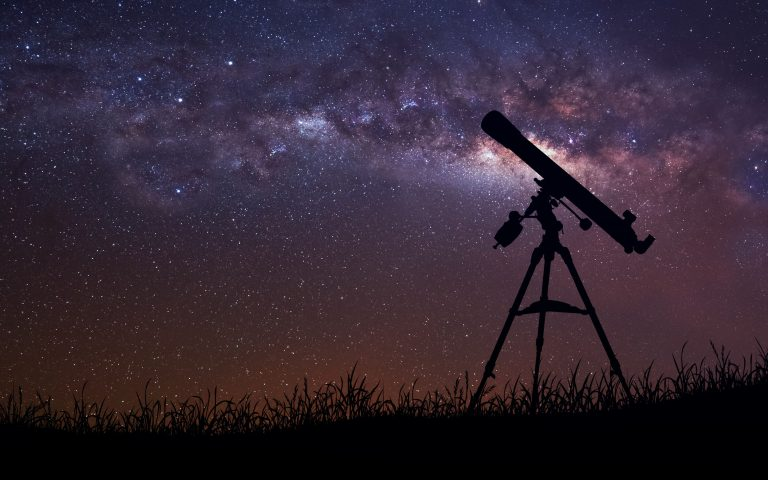
Looking up at the star-filled sky with the bare eye reveals stars to us as small points, twinkling in the darkness. But we cannot see how far and how deep the universe is. That is where the telescope enters. As time machines, they don’t merely magnify space; they extract light from millions or billions of years in the past. They don’t merely let us see stars through them. They allow us to see history. In their simplest sense, telescopes are light gatherers.
Optical (e.g., the Hubble Space Telescope), radio (e.g., the Very Large Array), and infrared (e.g., the James Webb Space Telescope) are all designed to collect light, whether visible or not to the human eye.
Far-away galaxies are extremely faint and far away, and every additional photon a telescope captures is a fragment of a mystery from the distant past. The farther away a galaxy is, the further its light has had to travel, and therefore we are essentially viewing how it appeared billions of years prior. But how exactly do telescopes assist in discovering those galaxies, rather than merely observing them? Here's a step-by-step explanation:
Redshift detection: The moving galaxies are detected through their redshift, or the way their light is shifted into the red end of the spectrum. The more they are shifted, the farther away they are.
Multi-wavelength vision: Some galaxies are obscured by clouds of dust. Infrared telescopes (such as JWST) are able to pierce through that dust and uncover what lies within.
Deep-field imaging: Spacecraft such as the Hubble telescope have taken a "deep field" by pointing towards what appeared to be empty space for days and seen thousands of galaxies that were previously unseen. What's really exciting is how telescopes enable us to map the structure and evolution of the universe. Take the way galaxy clusters inform us about how gravity functions on a cosmic scale, for instance. And some even allow us to detect dark matter by looking at how galaxies warp light (gravitational lensing) a prediction of Einstein.
We're not merely looking at galaxies, we're observing physics in action. More astonishing still is the ingenuity involved in the design of these scopes. They aren’t giant lenses pointing skyward. JWST has a tennis-court-sized sunshield that keeps it cold enough to spot faint heat from galaxies that formed when the universe first began. There are even concepts for future scopes using formation flying, several mirrors flying in space, and coordinating to act as a single enormous eye. At their core, telescopes are humanity's eyes reaching far beyond our planet and far into the depths of time.
They don’t merely bring new worlds into view. They redefine how we see our position in the universe. With every new discovery in a new galaxy, we are reminded by whispers from the past that the universe is both old and vibrant and we're just beginning to hear.
-----------------------------------------------------------------------------------------------------------------
Citations
https://www.wired.com/story/astronomers-just-broke-the-record-for-the-oldest-galaxy-ever-detected-james-webb-space-telescope/?


Comments